By Isaac Roberts, Chief Strategy Officer, Skyways
In case you missed it this April, the Department of War dropped the most significant demand signal the autonomous logistics industry has ever seen.
Buried in the FY27 budget request , within the $53.6 billion Drone Dominance initiative, is a line item in Section 7 that should be pinned to the wall of every defense investor and program executive officer: $13.5 billion for Contested Logistics specifically to "establish a commercially integrated logistics network capable of sustaining autonomous operations under contested conditions."
Read that again. Not to study the concept. Not to fund a phase one prototype from a team that's never flown over saltwater. To establish the network. To stand it up. To make it real.The budget still has to pass Congress and there’s no predicting the outcome; regardless, the line item firmly establishes that demand is real and pressures are peaking.
For those of us who have spent years building this capability in the field on U.S. Navy destroyers, Japan Maritime and Air Self-Defense Forces (JMSDF) ships off the Boso Peninsula, and over the first island chain, this isn't a surprise. It's confirmation that the DoW has caught up to what the operational realities have been telling us for years.
The question that matters now is: who's ready?

Let me give you the problem in terms that any warfighter who's done a deployment understands.
You're on a destroyer 1,400 miles from the nearest friendly port. One of your critical systems just went down. The part that fixes it weighs 40 pounds. The Seahawk, a $50M aircraft with a trained aircrew, is your current option. That Seahawk has a combat radius of roughly 250 miles. You're not getting the part today. Maybe not tomorrow.
Or you're a Marine or warfighter at an austere forward position. Your logistics tail is a two-day convoy through contested territory, a convoy that announces your position and puts people at risk. You need batteries, MREs, and blood. You need them now. The joint airlift request is likely sitting in a queue.
The proliferation of autonomous systems in modern conflict (and anyone watching what's happened in Ukraine understands this) has outpaced the doctrine designed to support the warfighter. Legacy infrastructure isn’t capable of meeting the needs of today’s dispersed operational environment.
You can't run a drone-enabled fight on a logistics model designed for the 1990s.
That's why the DoW is putting $13.5 billion toward a solution. Not as a nice-to-have, but as a strategic imperative.
Eight Years of Proving It Out
I want to be direct about something, because it matters for how you evaluate any company claiming they're ready to participate in this.
DoW contracts don't fall out of the sky. They're earned through consistent, repeatable execution. The more a company does what it says it's going to do, the bigger its next contract becomes. The less it delivers, the faster it disappears. There are countless companies that raise hundreds of millions of dollars, win massive DoW contracts, put their names on paperwork, and then quietly cease operations because they couldn't execute.
Skyways has taken the opposite path.

Our work with the military started with the USMC at White Sands in 2018 flying BVLOS beyond 60 miles in a challenging environment. The Marines loved what they saw. They also told us exactly what they needed that we didn't yet have: more payload and more range. That feedback became our roadmap. We didn't argue with it. We went back to the drawing board.
Then came the Navy, where energy density was the fundamental constraint. Batteries couldn't deliver the endurance real missions required, so we made the switch to heavy fuel using JP-5, JP-8 compatible, the lifeblood of the Navy. We built a hybrid propulsion system that nobody in the industry could match, and most are still catching up on today. In 2019, we won the Navy’s Advanced Naval Technology Exercise (ANTX), a competitive Navy evaluation of 65 UAS companies. Two showed up: Boeing and Skyways. We won. We again found ourselves up against a much larger competitor, Martin UAV (now Shield AI), and again, we took the top spot. Patterns prove performance.
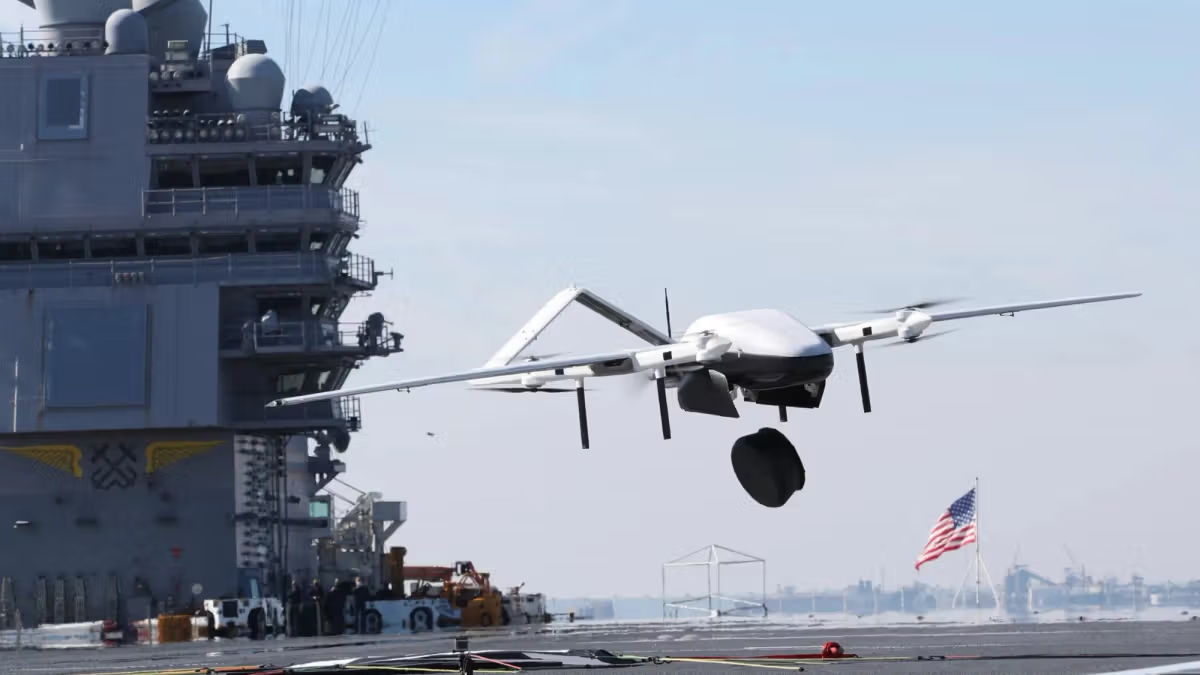
What followed was six years of field validation that you simply cannot replicate in a test environment: carrier deck trials on USS Gerald R. Ford, ship-to-ship autonomous deliveries between a destroyer and an oiler — no Skyways personnel onboard and Navy operators running the missions themselves. The first logistics UAV integrated into a U.S. fleet exercise at Fleet Battle Problem 23-1; three aircraft launched and recovered from USS Curtis Wilbur during RIMPAC 2024. Temperature-controlled blood delivered across 300 miles with III Marine Expeditionary Force.
And through all of it — every milestone, every contract — we delivered. 100% completion rate. Not because we set easy milestones. Because that's how we operate.
Our record in defense is unmatched and is what earned us the largest STRATFI ever awarded to a cargo UAS company: $37 million from AFWERX, sponsored by Air Force Special Operations Command, to take the V3 aircraft from prototype to full-rate production.
The V3 Platform: Built for This Mandate
When the DoW writes about establishing "a commercially integrated logistics network capable of sustaining autonomous operations under contested conditions," they're describing very specific capability profiles. For the airlift portion (particularly critical in the Pacific and remote areas), they’re talking about long range, with real payloads. Vertical Takeoff and Landing (VTOL) so you don't need a runway. Full stack autonomy so one operator can supervise multiple aircraft. Multi-mission capabilities so the platform earns its keep across more than one contract line.
Skyways V3 was designed for exactly this:
That last point deserves more emphasis than it usually gets. When you design for a modular, standardized interface, the aircraft is not a cargo platform. It's a mission platform. What do you want in the box? Blood and pharmaceuticals for a dispersed island position? Last-tactical-mile ammunition resupply? Signals intelligence collection equipment? Persistent overwatch sensors? EO/IR? A Starlink dish that's too large for a small FPV drone but fits neatly in our bay, turning the V3 into a comms relay node for a swarm of kinetic systems?

There's something important I need to say to anyone evaluating companies in this space, whether you're a program executive or a limited partner in a defense tech fund.
Ninety percent of commercial drone manufacturing is currently controlled by China. There is no scaled U.S. incumbent ready to supply the kind of autonomous logistics network the DoW is now trying to build. What there is, instead, is a long list of companies that have started from the concept or prototype stage, told excellent stories about future capability, and expected DoW to wait while they figured out how to actually build the aircraft.
That is not how defense acquisition works. Not at this scale, and not with the urgency our national security demands.
The DoW's contested logistics requirement isn't a research program. It's a procurement mandate. The language in the FY2027 budget request is explicit: this funding supports "thousands of modular container platforms, production-ready system designs, and high-tempo commercial repositioning." The key phrase is “production-ready.” Not “eventually-production-ready.” Not “promising-path-to-production-ready.”
Production-ready now.
I think about the defense procurement audience the way a Navy admiral thinks about it: these are people who determine what tool the warfighter uses, and they understand that the wrong decision puts lives at risk. They've seen plenty of Theranos-style handwaving — big promises, no delivery, and the guys in the field are still waiting. They're not interested in more of the same. Instead, they need to see it, feel it, and trust it. It has to work the way an AK-47 works — even with dirt in the mechanism, it still fires.
Skyways' aircraft has been tested in real conditions that weren't in the flight plan. During our Project ULTRA demonstrations in North Dakota — the first autonomous BVLOS cargo flights between two U.S. airports , no chase aircraft — the V3 experienced a cruise engine failure mid-flight. The autonomy stack transitioned the aircraft to VTOL mode before any operator touched the controls, executed a controlled descent from altitude, and landed cleanly in a wheat field with no damage. We call that aircraft "Wheat Whacker." The data from that incident was as valuable as the twenty clean deliveries we made that week. That's what real operations produce.
What $13.5 Billion Actually Means
For investors and decision-makers thinking about how to allocate against this budget line, the context is important.
The DoW is buying outcomes, not hardware. Those are the same first principles that Skyways has operated from since day one: the logistics structure the world operates in is outdated.
The DoW knows that dramatically improved outcomes result from modernizing logistics sites and container platforms, repositioning capacity, and reframing the entire architecture around mass production and autonomy. Runways are optional. Deliveries can now be bespoke and scaled.
What that means for a company like Skyways–which has been fighting for a more distributed logistics footprint for all of society, since inception–is that we’re all in.
For the commercialization picture, as we’ve seen time and time again, this military-focused technology improvement will transfer over to yield massive gains for the civilian sector at a later date. The key differentiator is that this is the same type of industrial revolution that made Detroit an economic powerhouse. But this time it will be Detroit on steroids, distributed across the U.S. with outsized leverage that only autonomy provides, tying utility to production.
So at Skyways, to drive that utility, we own the network and operate the aircraft wherever needed. Customers contract for logistics capability, not for a UAS program they have to staff and maintain. That model works at every acquisition tier and does not require a full program of record to start. Operations and maintenance funds controlled at the commander level are what move this capability forward. As Kevin Eastland, our VP of Business Development for Defense, puts it: “you can try before you buy.” We integrate into your operations, we operate the system, there's less risk, and you don't have to train anybody.
The cost arithmetic is not complicated. Skyways autonomous operations run 90%+ less per flight hour than an MH-60 Seahawk. You eliminate crew risk in contested airspace. You can operate from austere locations with zero runway infrastructure. And 90% of Navy high-priority CASREP parts weigh under 50 lbs…well within our useful load.

By 2030, Skyways is targeting 56 dual-use hubs, approximately 1,000 aircraft, operations on six continents, and $1B+ in revenue. We're at $10M in 2025 and have doubled revenue every year for three consecutive years. Our next stop is bringing V3 production scale to 100+ aircraft by the end of 2028, standing up six operational hubs, and establishing a fleet operations infrastructure to execute at tempo.
The companies that will win this contract category are not the ones with the most ambitious slide decks. They're the ones whose customers already trust them, because they showed up, did what they said, and came back with something better. Skyways has been doing that since 2017. We have the heritage. We have the aircraft. We have the operational proof.
The DoW needs $13.5 billion worth of what we've spent eight years building.
LFG.
Isaac Roberts is the Chief Strategy Officer for Skyways, an autonomous air transportation company building the world's largest autonomous cargo air network. Learn more at go.skyways.com .
Ten minutes into our first conversation, you’ll know you found the right partner. We ask the right questions, identify and propose the best solutions, and follow through down to the detail with exemplary build quality.