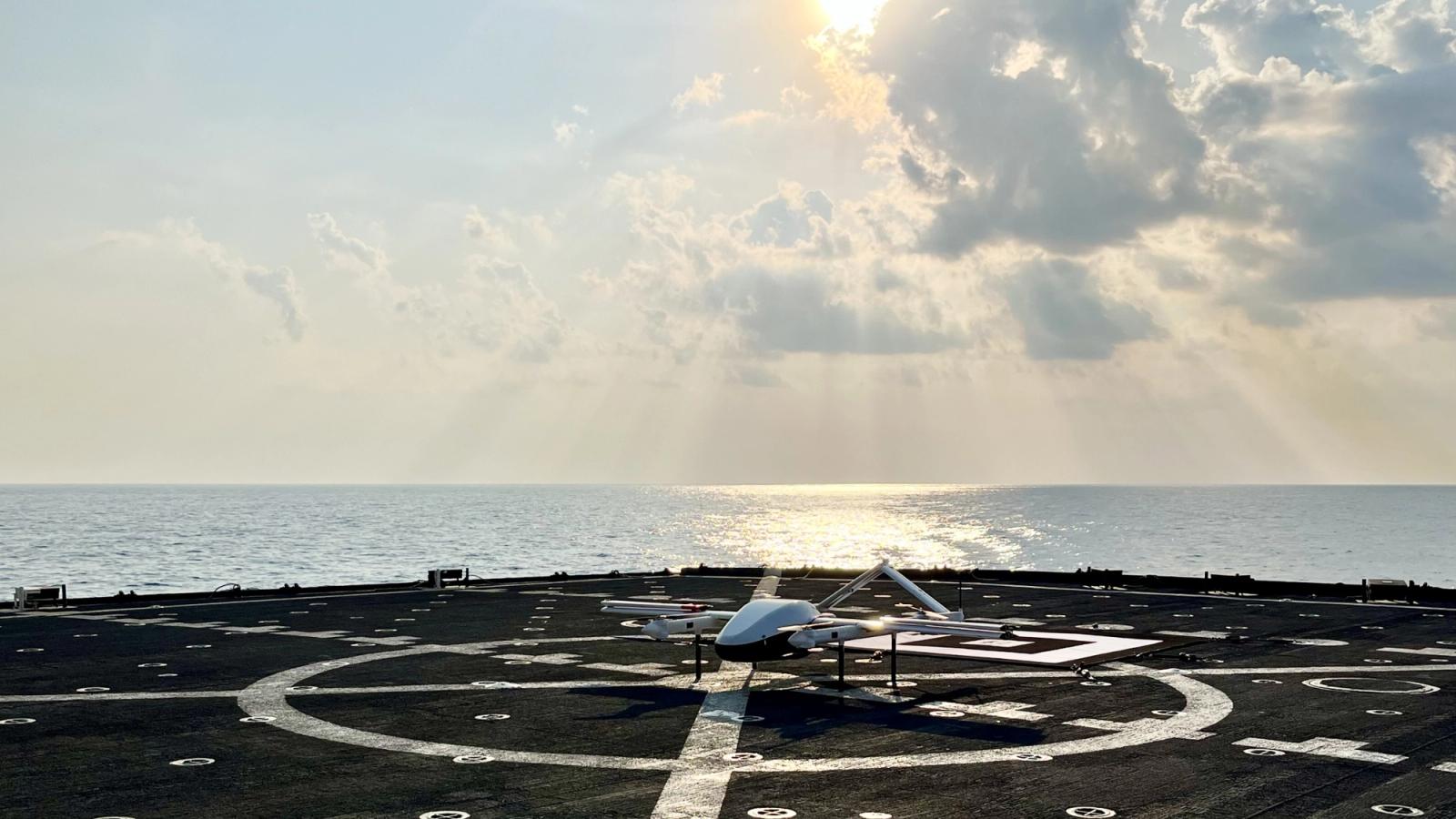
Somewhere in the Atlantic, a Skyways V2 lifts off from the deck of USNS Joshua Humphreys, a replenishment oiler, and banks toward open ocean. Less than an hour later, it approaches USS Bainbridge, a guided-missile destroyer making way through moderate swells. No pilot aboard. No chase aircraft. Telemetry locates the ship on the horizon and builds the approach autonomously. Computer vision handles the precision landing on deck. The package lands on target.
On the destroyer, the reaction is immediate. On the oiler, a Navy crew is already prepping the next sortie.
Consider what this capability means at the level where missions either succeed or fail. When a forward-deployed destroyer like the Bainbridge needs a critical part, the mission can grind to a halt until it arrives – a single point of failure with outsized repercussions. Traditionally, closing that gap means burning a helicopter on the task and putting a crew at risk, or waiting on a resupply ship. A day lost. Sometimes more. A destroyer at reduced readiness in a contested environment is a problem that compounds by the hour.
The Skyways flight proved an alternative. Ship-to-ship, open ocean, fully autonomous, conducted by a Navy UX-24 test team with no Skyways personnel aboard either vessel. An autonomous aircraft launching from a floating warehouse operating in the rear turns a mission-stopping failure into a "just hit go" moment. One of many Skyways has executed for the U.S. Navy since 2019 – the kind of mission the company was built for: move critical cargo across distances and environments where manned alternatives are too expensive, too inefficient, or too dangerous.
How a company founded in Austin, Texas, in 2017 arrived at that moment, and where the operational record is heading next, starts with a Marine who needed something yesterday and a team that listened.
Skyways' defense story starts with a real problem and a customer who needs it solved fast.
The problem? Troops in contested environments need autonomous on-demand resupply – MREs, batteries, blood for transfusions, ammunition – delivered by air, without putting additional personnel at risk.
The solution? Exactly what Skyways CEO and founder Charles Acknin had begun to develop in 2016, before he launched a company. That year in San Francisco, Acknin built what would become the Skyways V1: a small, eVTOL prototype, inexpensive enough to crash, learn from, and rebuild. He founded the company in 2017, moved the work to Austin, and through that year the team carried V1's approach forward into larger aircraft – V2.0 and V2.2, still all-electric, now on carbon-fiber composite airframes.
This match between problem and solution became a contract. In November 2017, the USMC issued Skyways a purchase order for two V2.2 aircraft – the company's first defense contract, and the start of its work with the U.S. military.
The Marines took delivery in the spring of 2018 and put the aircraft in the field at White Sands – Skyways' first BVLOS flight. They validated the concept, then told the team exactly what every customer tells every vendor who shows up with something promising: this is great, but we need more. As Isaac Roberts, Skyways' Chief Strategy Officer, recalls: “The Marines loved it, and it was all electric. And they said, 'This is amazing. We love this. But we need more payload and more range.'”
That feedback – from a real customer, after field evaluation – became the product roadmap. A Marine looking at the aircraft and saying: go further and lift heavier.

Meeting the Marines' demand meant rethinking the aircraft from the energy source up. Batteries couldn't deliver the endurance the military needed. The Navy, which operates strike groups thousands of miles from port and depends on underway replenishment to keep ships fighting, became the next customer. Aviation operations aboard Navy ships run on JP-5.
In March 2019, the Navy organized the Advanced Naval Technology Exercise (ANTX) at NAS Patuxent River, a competitive evaluation of unmanned systems for autonomous cargo resupply to a naval vessel. The Navy evaluated 65 UAS companies. Two showed up: Boeing and Skyways. Skyways won — flying V2.2, still all-electric — and opened the Blue Water UAS program under NAVAIR.
The follow-on OTA contract funded the transition from V2.2 (all-electric) to V2.5 (hybrid), extending the aircraft's range roughly 8x. Skyways was one of the first cargo UAS companies to go hybrid. Most of the field is still catching up. Battery for VTOL, heavy fuel for forward propulsion, an airframe built for efficient cruise: up to 450 miles of range, up to 30 lbs of useful load, foldable wings for shipboard storage, and compatibility with JP-5, JP-8, and fuels readily available aboard military vessels.
What followed has been six years of validation with the Navy. Carrier deck trials on USS Gerald R. Ford. Ship-to-ship flights between a destroyer and an oiler, conducted entirely by a Navy UX-24 test team. 200+ nautical-mile multi-mode deliveries at Pax River. The first logistics UAV ever integrated into a U.S. fleet exercise at Fleet Battle Problem 23-1. Three aircraft launched and recovered from USS Curtis Wilbur during RIMPAC 2024. Temperature-controlled blood delivery over 300+ miles with III Marine Expeditionary Force. Through all of it, and it wasn't always smooth, Skyways never missed a DoW milestone.

As Isaac Roberts puts it: “A lot of companies go and get massive contracts and then don’t make any money from them because they promise the world and can’t deliver anything. Charles is very much a straight shooter – if I’m going to say I’m going to do X, I’m going to go and do X.”
The Navy’s experience with Skyways produced a consequential recommendation: take this to the Air Force. The Navy had validated the platform at sea. The Air Force controlled the pathway to scale it across the DoW.
In May 2025, that transition landed: a $37 million AFWERX STRATFI contract to take V3, Skyways' next generation aircraft leveraging much of V2, from prototype to full-rate production. Sponsored by Air Force Special Operations Command. The acquisition pathway from SBIR Phase I ($47K) through STRATFI ($37M) represents ~800× contract growth.
In July 2025, Skyways completed what no autonomous cargo aircraft had done in the United States : airport-to-airport BVLOS flights between Grand Forks Air Force Base and Cavalier Space Force Station in North Dakota. 60 miles apart. Controlled national airspace. No chase aircraft. Most UAS programs operating in U.S. airspace still require a manned aircraft shadowing every flight. Skyways flew ten round trips, twenty operational missions, as the sole unmanned aircraft provider in the DoW’s Project ULTRA exercise, sponsored by the Office of the Under Secretary of Defense.
230 lbs of cargo delivered, including temperature-controlled blood. First repeat autonomous BVLOS flights without a chase plane between two airports.
Then came the V3 demonstration. The aircraft’s first customer BVLOS flight in national airspace.
While climbing to 3,500 feet, four times the altitude most cargo UAS ever reach, one cylinder on V3’s cruise engine failed. The other cylinder continued firing, which masked the problem. The aircraft was still moving forward, but the speed was wrong. And in aviation, “moving but slow” is not a category you want to occupy for long.

Before anyone touched anything, the autonomy stack had already responded. The aircraft transitioned to VTOL mode, spooling up the electric motors while the team identified the issue. A pure fixed-wing aircraft in that situation gets one attempt at an unpleasant dead-stick landing. Skyways’ Separate Lift Cruise architecture handled it differently: cruise engine quits, VTOL motors take over. The team executed a controlled descent from altitude, a vertical landing profile no cargo UAS had attempted at that height.
A few minutes later, the aircraft touched down in a North Dakota wheat field with no damage. Post-flight inspection revealed approximately ten seconds of remaining battery capacity at landing. The aircraft earned the name “Wheat Whacker.” The data from that descent was as valuable as twenty successful deliveries. Power draw under emergency conditions. Autonomous transition behavior. Operator workload during degraded flight. All of it real, all of it logged.
That's the difference between flying in a controlled test environment and flying real operations. Test environments tell you the aircraft works in conditions you expected. Real operations tell you how the aircraft performs in conditions that are often less than ideal. And they generate data from moments that weren't in the flight plan.
Charles Acknin frames it this way: “It's trivial to do a one-off demo at your test site. Flying real-world missions with paying customers is the true acid test.”
Heritage earns the first conversation. But the conversation that matters is what comes next.
Lt. Gen. Jake Jacobson spent 34 years in the Air Force, his last three as a senior commander in the Indo-Pacific, war-planning against the scenarios that keep the Pentagon up at night. He now advises Skyways. He describes the geography in terms anyone can grasp: fly five or six hours from Denver to Hawaii. Change planes. Seven hours to Guam. Get briefed, climb into an F-35, and it is still a three-hour flight with multiple air refuelings to reach a working position 400 miles east of Taiwan. Below you, nothing but ocean.
"The challenge is how do you move things?" Jacobson says. "How do you find places to operate from when you have limited land features? Every viable position is critical, which means the logistics of moving between them become the whole problem."
From the first island chain (Japan, the Philippines, the Okinawa arc) to the second island chain around Guam, the logistics problem isn’t theoretical. It’s the defining constraint. Ships can’t concentrate; they’re easier targets together. Dispersed forces need resupply that doesn’t require proximity, doesn’t require human crew in contested airspace, and doesn’t wait in line behind a joint airlift request that may take two days to fill.
Skyways is already operating inside this problem. In August 2024, Skyways delivered cargo autonomously from land to a Japan Maritime Self-Defense Force destroyer at sea off the Boso Peninsula — supplies released on target, the ship underway. Across Okinawa Prefecture, the same platform is running long-distance temperature-controlled pharmaceutical and blood delivery across maritime and inter-island routes – the exact mission profile a forward-deployed unit needs when a ship or a dispersed position requires medical resupply across open water.
The same logic extends ashore. Agile Combat Employment disperses airpower across contested territory, spreading operations to austere sites that ground convoys can't reach and fixed bases can't support. Those dispersed locations need logistics support – predictable, reliable resupply that a commander can count on as part of a layered sustainment system augmenting existing airlift assets.
Kevin Eastland, Skyways’ VP of Business Development for Defense and a retired Air Force C-17 mobility pilot, puts it directly: “The longer that back supply chain tail is, the more challenging it is going to be to win a battle. The ability to operate in an austere environment, to not require a runway … to not even need to land to deliver supplies. That gives a commander options. And that’s what this is about. Giving warfighters options.”
Jacobson, who has spent more time than most thinking about what unit-level logistics capability means in a fight, says it simply: “If I gave you 10 Skyways aircraft and you never had to ask anybody for permission – you can be much quicker, much more effective.”
The V3 platform is built for this mission. Up to 100 lbs of useful load. 1,000+ miles of range (payload dependent). 20 hours of endurance. The strategic piece is the 7-cubic-foot modular cargo bay: the same airframe that delivers water, blood, and batteries to a forward operating base will be able to carry signals intelligence equipment, EO/IR sensors, or communications relay payloads. As Isaac Roberts frames it: “What we’ve been building is a 7-cubic-foot box that can carry 100 pounds that goes into an aircraft. What do you want in the box? Because when you design for modularity and interoperability, it doesn't matter what goes in – you've got a multi-role platform, not just a cargo aircraft.”

Building a reliable uncrewed aircraft is one problem. Deploying it in a way that matches how the DoW actually acquires and operates capability is another. Skyways is building an autonomous air network, and that means meeting defense customers where they are. Contractor-Owned, Contractor-Operated (COCO) is often the fastest on-ramp, especially for units that want capability without standing up a UAS program. But the platform is built to flex – COCO, GOGO (Government-Owned, Government-Operated), or anything in between – depending on what the mission and the acquisition authority call for.
Kevin Eastland explains why this matters for initial deployment: “You can try before you buy. We can integrate our capability into their operations. We operate it. There’s less risk. They don’t have to train anybody. They can use a completely different pot of money – operations and maintenance funds, controlled at a much lower level. It’s a commander-level decision, not a program office.”
The cost arithmetic is straightforward. A single MH-60 Seahawk helicopter sortie is incredibly expensive and requires a trained aircrew. Skyways autonomous operations cost 90%+ less per flight hour than an MH-60 Seahawk, require no aircrew, and free scarce rotary assets for missions that require human presence.
But cost is only part of the equation. The deeper change is what happens when organic logistics capability gets deployed at the unit level. The most junior operator at a forward operating base, the enlisted service member who actually needs the resupply, can load, launch, and monitor the mission without specialized aviation training. Capability at the tactical edge, without fighting the system to get it.
Every generation of Skyways aircraft builds on what came before, shaped by what customers ask for next. V1 was the origin: a small all-electric prototype. V2 rebuilt from the energy source up to meet Navy range requirements, and has flown maritime missions for the Navy and allied forces since 2019. V3 is the output of eight years of defense customer feedback, and the $37M STRATFI contract is taking it to full-rate production.
The thread connecting all three: each generation iterates based on direct warfighter input. V1 proved the concept. V2 earned the first Marine and Navy contracts. V3 earned the STRATFI. As Charles Acknin says: "We started really small, and we showed it to customers and we asked, 'Is this useful? What can you do with it?' Because we got that feedback very early, we knew where to take the company next."
What comes next is production scale, operational tempo, and proving out the mission sets that the last eight years have been building toward. Contested last-tactical-mile resupply across the Indo-Pacific. Service-retained logistics for units that can’t afford to wait on joint airlift. Fleet-scale autonomous operations running dozens of sorties per day. The path to Program of Record.

The companies that will define military autonomous logistics won’t be the ones with the most ambitious pitch decks. They’ll be the ones whose customers trust them because they showed up, did what they said, and came back with something better the next time. As Jacobson puts it: “In the end, people want heritage. They want to see that it works.”
Skyways has the heritage. Charles Acknin describes it this way: “We received feedback from one of our customers saying that the Skyways aircraft is like nothing they’ve seen before. They’ve tried before – many other airplanes, many other OEMs. Over-promised, under-delivered, trust lost. That would probably be the biggest moat. Unfortunately it’s a boring moat. It’s just doing what we said we would do, consistently every time.”
Boring moats tend to be the ones that hold.
What is Skyways’ track record with the Department of War?
Skyways has achieved 100% milestone completion on every DoW contract awarded – spanning the U.S. Marine Corps (first V2.2 purchase order, 2017), Navy (Blue Water UAS program under NAWCAD), and Air Force ($37M AFWERX STRATFI). The company has operated off an aircraft carrier (USS Gerald R. Ford, CVN-78), destroyers (USS Bainbridge DDG-96, USS Curtis Wilbur DDG-54), and oilers (USNS Joshua Humphreys T-AO-188, USNS Patuxent T-AO-201). Skyways won ANTX 2019 – selected from 65 UAS companies and beating Boeing – and has since flown real-world missions at Fleet Battle Problem 23-1, RIMPAC 2024, and Project ULTRA. Allied defense missions with the JMSDF and JASDF add international operational validation. $50M+ in total government contracts. Over 43,000 kilometers flown.
What differentiates Skyways from other autonomous cargo aircraft companies?
Heritage. Skyways didn’t adapt a commercial product for defense – defense requirements funded and shaped every product iteration. The V2 was built specifically for the Navy: JP-5 compatible, long range, meaningful payload, foldable wings for shipboard storage, designed from the ground up for maritime operations. Where competitors are adapting passenger or commercial aircraft for military cargo, Skyways built for the mission first. In a market where UAS companies routinely win contracts and fail to deliver, Skyways has a 100% milestone completion rate across every DoW contract awarded since inception. But also, Skyways is the only VTOL long-range cargo UAS deployed on 3 continents.
What are the V2 and V3 aircraft specifications?
V2 (current operational platform): 30 lbs useful load, up to 450 miles range (not simultaneous – payload dependent), 8+ hours endurance, JP-5/Jet A-1 compatible, foldable wings (~18.5 ft) for shipboard operations. Currently operating with U.S. military and allied defense forces. V3 (production platform in 2026): 100 lbs useful load, 1,000+ miles range (not simultaneous – payload dependent), 20+ hours endurance, 7-cubic-foot modular cargo bay configurable for logistics, ISR, SIGINT/ELINT, etc. V3 STRATFI funding transitions the platform to full-rate production. Both platforms use hybrid propulsion and are VTOL, i.e. require no runway infrastructure.
What is the STRATFI contract and why does it matter?
STRATFI (Strategic Funding Increase) is AFWERX’s mechanism for bridging the gap between Phase II development and Program of Record designation. Skyways’ $37M STRATFI, awarded in May 2025 and sponsored by Air Force Special Operations Command, is the largest STRATFI ever awarded in cargo UAS and one of the largest in the entire USAF SBIR program's history. It funds V3’s transition from working prototype to full-rate production. The acquisition pathway – SBIR Phase I ($47K) through STRATFI ($37M) – represents ~800× contract growth.
How does autonomous cargo resupply compare to helicopter logistics costs?
Skyways autonomous operations save 90%+ per flight hour when compared to an MH-60 Seahawk helicopter. Beyond cost reduction, autonomous operations eliminate crew risk in contested environments, operate from austere locations without runway infrastructure, and scale through organic unit deployment without competing for joint airlift assets. 90% of Navy high-priority CASREP parts weigh under 50 lbs, well within the useful load of Skyways V3.
What is Project ULTRA and why was it significant?
Project ULTRA was a DoW exercise (July 2025, OUSD-sponsored) where Skyways completed the first unmanned, fully autonomous BVLOS cargo flights between two U.S. airports – Grand Forks Air Force Base and Cavalier Space Force Station, 60 miles apart. Skyways flew 20 operational missions in controlled national airspace as the sole UAS provider, with no chase aircraft. 230 lbs of cargo delivered, including temperature-controlled blood. The exercise also included V3’s first customer BVLOS demonstration, during which an engine anomaly was handled by autonomous transition to VTOL mode and a successful emergency landing with no damage – producing operational data on fault tolerance and autonomous recovery.
What is Skyways’ service model for defense customers?
We are building the world’s largest autonomous air network. Skyways operates a Contractor-Owned, Contractor-Operated (COCO) service model: customers contract for logistics capability, not hardware. Skyways owns the aircraft and is accountable for every mission. No fleet to maintain, no UAS operations team to build, no specialized inventory to manage. Operations and maintenance funding – controlled at the commander level – can be used for COCO contracting, which lowers the acquisition barrier compared to a full program of record from the outset.
Why does Indo-Pacific allied validation matter for U.S. defense audiences?
When a U.S. ally’s military is already operating your platform in the exact theater that defines the strategic challenge, it demonstrates capability. The JMSDF and JASDF missions have validated Skyways’ capability in maritime and island environments across the Indo-Pacific. That allied operational record is a proof point that no demonstration can replicate.
Ten minutes into our first conversation, you’ll know you found the right partner. We ask the right questions, identify and propose the best solutions, and follow through down to the detail with exemplary build quality.