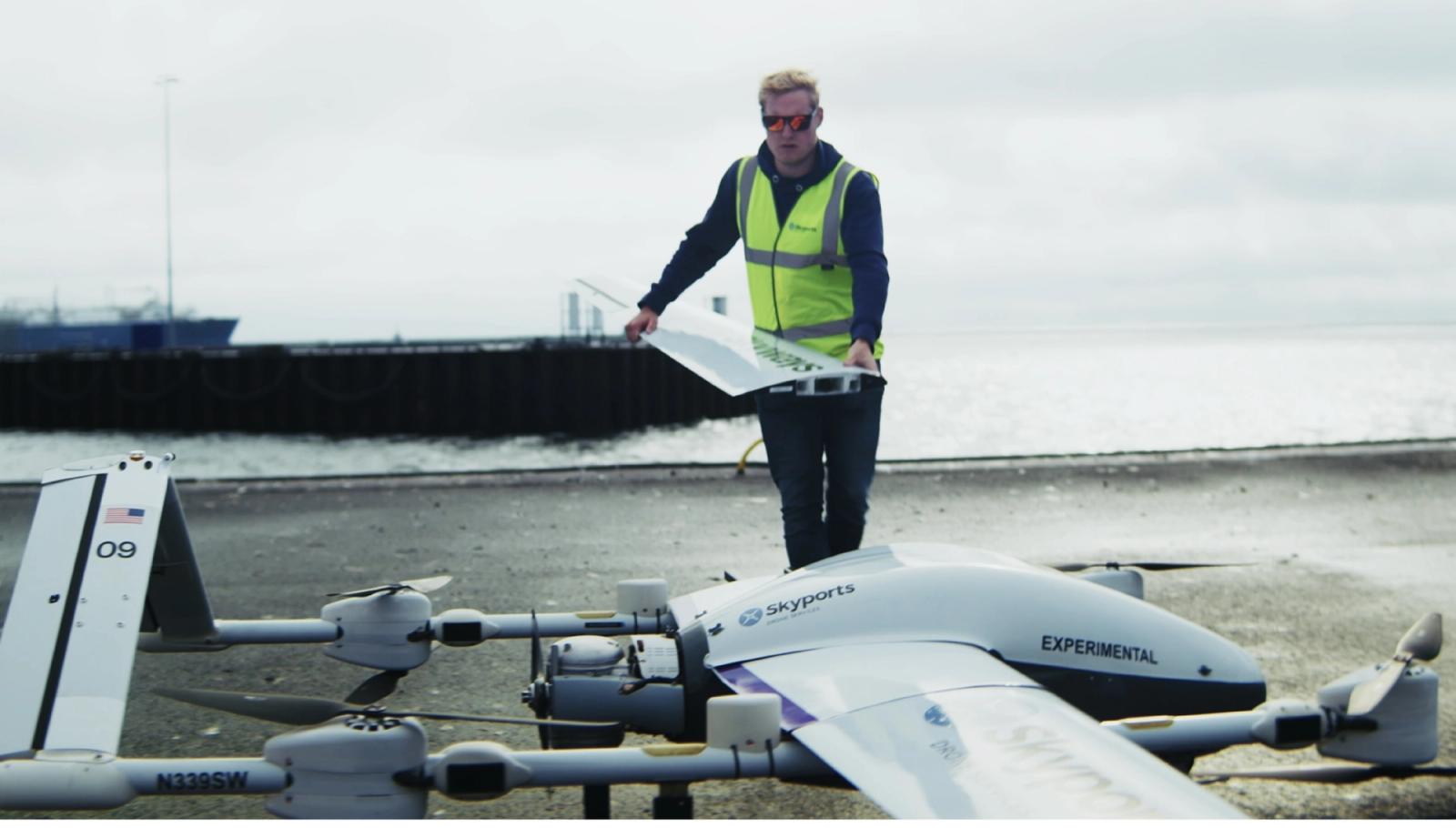

It was a restless morning on the North Sea, the kind of offshore weather that will test your confidence. From an RWE wind turbine, Skyports' Program Manager (Offshore) Harry Plested steadied his phone and watched as the Skyways aircraft eased into position above the turbine. Back at the shoreline ops center, Flight Operations Manager Peter Lawson followed the down-camera feed as the aircraft settled and released the package.
For a moment, no one said anything. Then the radios crackled, the feed showed clean placement, and the channels lit up. The reaction across Skyports crews in Germany and Skyways engineers in Texas was relief, recognition, and months of work validated in a single moment. The system worked beyond-visual-line-of-sight—no visual observers, no chase aircraft, just the aircraft, the autonomy, and fifty miles of open ocean.
The takeaway here was less about the delivery itself and more about what made it possible: months of preparation, 24/7 support, the willingness to jump onto calls at any hour, and a shared commitment to making something new work in the real world. Because nothing says partnership quite like engineers in Austin answering technical questions at 3 AM on a Tuesday.
"The support we got throughout all hours… someone willing to jump online and give us live support – that's something I've never experienced to that level." — Peter Lawson, Flight Operations Manager, Skyports
That moment validated a way of working. Skyports brought operational discipline and real-world demands. Skyways matched it with a service-first partnership designed for dependability in the hardest environments.
A single drop became the proof of a model built to scale.

Skyports Drone Services is one of the most capable unmanned aviation operators in the world, running BVLOS cargo missions and inspections across offshore wind, oil and gas, and critical infrastructure—environments where procedures, safety, and repeatability matter far more than polished demos.
At Arkona, the work was led by Peter Lawson, Flight Operations Manager, and Harry Plested, Program Manager (Offshore), who together brought thousands of hours of experience in weather-exposed missions where reliability is the only metric that matters.
Their expectations were straightforward: the aircraft must perform under real constraints, its autonomy must behave predictably in turbulence and changing conditions, and its manufacturer must respond quickly with solutions grounded in real-world use.
For Harry, the work leaves no room for theatrics. "There's no point writing fancy reports and doing shiny demonstrations if that's all it is," he explains. "This is about running operations every day."
He also believes running operations means judging an aircraft by what it accomplishes in the field. "Unless it's in the air and flying, it's a pointless waste of time."
Which is a polite way of saying: if your aircraft looks better in PowerPoint than it does in 30-knot winds over the North Sea, you're in the wrong business.
That mindset reflects why this partnership works. Skyports brings operational realities. Skyways matches it with the responsiveness and maturity to meet those expectations.
As Skyways CEO Charles Acknin says, "We put it in customers' hands, get live feedback, and make it do exactly what we said it would do in the real world."
That approach has taken Skyways aircraft to three continents, flying with customers where dependability isn't negotiable. Arkona showcased a partnership built for daily operations.

From the beginning, Skyports and Skyways built a shared operating model that treated the mission as joint responsibility. Skyports acted as the service operator, running flights, managing risk, and working directly with RWE on site. Skyways functioned as the autonomous airline behind those operations, providing the aircraft, autonomy system, training, documentation, and real-time support.
The partnership ran on a steady rhythm: daily readiness briefs, joint flight log reviews, transparent issue tracking, and a 24/7 engineering line connecting offshore operators directly to Skyways engineers in Texas. The effect was a level of responsiveness that felt immediate even halfway across the globe.
"Without Skyways adaptability this would not have been possible," Peter emphasizes.
That adaptability mattered most when conditions changed. Days before live operations, Skyports identified a tailwind detransition concern that required updated logic and new validation work. The schedule left no room for prolonged troubleshooting—or the typical industry response of "we'll add it to the Q3 roadmap."
Skyways ran simulations, tested with an aircraft in Texas, and analyzed eight years of logged flight data. The updated parameters arrived in less than 48 hours.
"We could jump on a live call at short notice to discuss emergency procedures and make a clear and concise decision on that risk," Peter notes.
The partnership strengthens both sides. Skyports gained dependable autonomy, predictable behavior in harsh offshore conditions, and a support model aligned with real operational tempo. Skyways gained an elite operator that pressure-tested the system, surfaced real constraints early, and helped turn procedures into repeatable products for future customers.

The partnership found its proving ground when Skyports needed to deliver for one of Europe's largest energy companies. RWE operates the Arkona wind farm. Skyports is their offshore drone operator. Skyways partnered with Skyports to deliver the autonomous capability that made the service work.
"After months of testing, we've reached the beginning of a new era for offshore logistics in Germany. At our Arkona and Nordsee Ost wind farms, we completed more than 80 successful offshore cargo drone flights. Fully autonomous Beyond-Visual-Line-of-Sight (BVLOS) flights took off from Mukran Port on Rügen, flew to the Arkona wind farm, locked onto the turbine nacelle and performed an automated cargo drop before returning safely to port — marking Germany's first fully compliant BVLOS offshore deliveries." — Sven Utermöhlen, Chief Operating Officer, RWE Generation
The arrangement matters because it shows how value flows. By enabling Skyports to deliver reliably for RWE, Skyways strengthened Skyports' commercial position and created a repeatable model Skyports could offer to other offshore operators.
The technical challenge was straightforward: dependable wind turbine resupply in demanding offshore conditions where boats and helicopters are frequently limited. The approach was methodical—ground validation, shoreline flights, offshore rehearsals, and live deliveries, refining flight logic and abort criteria at each step.
"With the flight logic that Skyways developed it was a really nice, scaled and safe approach which allowed us to take it step by step," Peter explains.
The missions ran fully autonomous BVLOS: 50-mile round trips with no visual observers, precision placement onto turbines hundreds of feet above the sea, and loiter capability that let the aircraft wait until technicians signaled readiness. After each flight, the teams reviewed data together and updated parameters between sorties.
When Skyports surfaced a tailwind landing concern shortly before operations began, Skyways ran simulations, tested an aircraft in Texas, and pulled from years of logged flight data. The validated update arrived within 48 hours.
"All the information came through swiftly and caused less than a twenty-four hour delay to the project," Peter recalls.
What mattered most wasn't the complexity of any single flight—it was proving the process could be repeated. Skyports now has a service package they can offer across similar offshore environments. The procedures, training materials, and risk assessments become the foundation for new sites.
"It was probably one of the most complex missions we could undertake," Harry reflects. "It gave us confidence that anything else is going to be easy."
The model works commercially, not just technically. Skyports gained credibility with RWE and positioned themselves to win similar programs. Skyways demonstrated that dependable autonomy translates directly into customer advantage.

This partnership proved a simple principle: when operators gain BVLOS autonomy they can depend on, they gain services they can sell. Flying beyond-visual-line-of-sight isn't just a technical capability—it's what makes offshore logistics commercially viable.
Skyports walked away with a repeatable offshore resupply offering that fits naturally into turbine maintenance workflows, responds to technician readiness in real time, and delivers critical parts more efficiently than boats or helicopters. That's a commercial advantage they can scale.
Skyways makes that possible through a complete service model where aircraft, autonomy, documentation, training, and support work together. The technology handles offshore turbulence, automated aborts, and precise placement around rotating infrastructure. What matters to customers is what it unlocks: new revenue streams and stronger competitive positioning.
The speed of improvement matters just as much. When Skyports needs a parameter change or autonomy refinement, it arrives in days.
"That feedback loop is always well received," Peter notes. "Skyways turn it around super fast and get us that solution back in no time."
That responsiveness creates a scalable foundation. The procedures and playbooks transfer to other wind farms. Training and documentation apply to new teams. The same system supports island logistics, remote industrial operations, and defense use cases with minimal adaptation.
"We can package it up and say to customers this is what we have achieved," Harry explains. "Your mission is relatively simple in comparison."
Skyports now has a proven offering. Skyways provides the infrastructure underneath. Together, they give offshore operators a path from experimental flights to dependable logistics that strengthens their business.

Skyports is flying with customers across three continents and using the mission to shape new commercial conversations. The service package confirmed at Arkona becomes the template for offshore wind operators across Europe and beyond. Each new site builds on the last because the procedures, training, and risk assessments are already proven.
"We now have something that is ready to start selling as a product," Harry notes.
Skyports isn't alone in reaching that milestone. Skyways is now scaling commercial deployment with customers across sectors and geographies. What began as proving dependability with early partners has evolved into operators building businesses on the platform.
That's the model: standardized service packages that operators can deploy with predictable results. Aircraft, autonomy, training, documentation, data interfaces, and 24/7 support come together as a system where reliability becomes contractual.
The development cycle runs at operational speed because customer experience drives the roadmap. Updates arrive in weeks, not quarters. Each deployment generates data and insights that feed back into the product immediately.
Regulatory momentum follows operational proof. Every safe BVLOS deployment adds to the evidence base regulators use, normalizing autonomous logistics across more regions and use cases.
The result is a compounding advantage. Each mission expands what the system can handle and what customers can offer.
"Every successful mission makes the next one faster to stand up and opens new routes our customers can own," Charles emphasizes.
What makes the Skyways-Skyports partnership different from typical OEM-operator relationships?
Skyways provides a complete operational package beyond aircraft delivery: training for operator crews, documentation and procedures, real-time 24/7 engineering support, and rapid autonomy updates validated through simulation and years of logged data. When field conditions change, operators get validated solutions in days, not quarters. This enables operators like Skyports to run independent autonomous operations and build sellable service offerings for their customers.
How does Skyways enable operators to commercialize autonomous services?
By providing transferable operational playbooks. The procedures, training curricula, risk assessments, and flight logic developed with one customer become ready-to-deploy templates for new sites. Operators gain a proven service package they can offer across geographies with predictable results – turning operational experience into commercial advantage.
What does "24/7 engineering support" actually mean in practice?
Operators have direct access to Skyways engineers in Texas regardless of time zone. When Skyports identified operational constraints in Germany, they could jump on live calls to discuss emergency procedures, review data together, and make clear decisions on risk – with validated solutions delivered within 24-48 hours when needed.
Who is Skyports and why does this partnership matter?
Skyports Drone Services is one of the world's most capable unmanned aviation operators, running BVLOS missions across offshore wind, oil and gas, and critical infrastructure. They bring thousands of flight hours and operational discipline in harsh, weather-exposed environments. Partnering with Skyports pressure-tests the Skyways system under real-world constraints and helps turn procedures into repeatable products for future customers.
Who is RWE and what role do they play?
RWE is one of Europe's leading renewable energy companies and the operator of the Arkona Offshore Wind Farm in the Baltic Sea. They set the mission need: dependable and swift resupply of small parts to turbines, where boats and helicopters are frequently limited by difficult conditions. Skyports serves as their drone service operator, while Skyways provides the underlying autonomous capability.
What did Skyports gain from working with Skyways?
A fully validated offshore resupply product they can offer to other wind operators. The procedures, training curriculum, and safety cases built at Arkona serve as a ready-to-deploy template for new sites. Skyports walked away with a proven commercial service offering – not just a successful demonstration.
How fast can Skyways respond to operator feedback and changing conditions?
When Skyports surfaced a tailwind detransition concern near the port days before operations, Skyways analyzed flight data, ran simulations, tested the update on an aircraft in Texas, and delivered validated parameters within 24-48 hours. Updates arrive in days, not quarters, because customer experience drives the development roadmap.
Were these operations conducted beyond-visual-line-of-sight (BVLOS)?
Yes. Every flight was fully autonomous BVLOS with no visual observers or chase aircraft. The aircraft flew 50-mile round trips over open ocean, navigated turbulent conditions around turbine structures, and executed precision deliveries - all beyond-visual-line-of-sight. This level of BVLOS maturity in offshore environments is what enables commercially viable autonomous logistics where boats and helicopters are frequently grounded.
What conditions did the system handle during offshore operations?
High winds, turbulence around turbine structures, tailwind transitions near port, variable visibility, and offshore clutter. The aircraft flew 50-mile round trips and executed precision drops onto turbines while maintaining loiter capability – demonstrating consistent, predictable performance in environments where reliability is the only metric that matters.
Why does this partnership model matter for the future of autonomous logistics?
Because it proves that operators can build commercial services on dependable autonomy. Each mission adds evidence, data, and maturity that accelerates regulatory confidence, shortens timelines for standing up new sites, and strengthens commercial viability across offshore energy, island chains, defense, and remote industrial sectors. Skyways' customers gain operational playbooks and support infrastructure that competitors can't replicate without flying paying customers in harsh environments.
Ten minutes into our first conversation, you’ll know you found the right partner. We ask the right questions, identify and propose the best solutions, and follow through down to the detail with exemplary build quality.