By Bill Wimberley, Chief Commercial Officer, Skyways
No one cares about the damn aircraft!
Harsh? Yes. True? Also, yes—at least for the customer.
Most drone OEM messaging still reads like a spec sheet: range, payload, battery chemistry, prop sizes, “AI,” and glossy renders.
Meanwhile, executives are asking very different questions:
- Will this measurably reduce downtime, risk, or cost?
- Can it be trusted in real weather and real operations?
- How does the workflow actually work—dispatch, loading, tracking, maintenance, compliance?
- Who owns the outcome if something fails?
- Does it integrate into how we already run the business?
That mismatch is why the market is crowded with “better aircraft” that never became better businesses.

Outcomes beat airframes
If drones are going to scale beyond demos, OEMs must stop selling aircraft and start selling outcomes:
- Define the job-to-be-done: “Move parts to an offshore site in under 30 minutes” beats “VTOL with X miles of range.”
- Quantify the pain: Vessel hours, stranded technicians, safety exposure, stockouts, SLA penalties, idle assets.
- Engineer the system—not just the vehicle: Reliability, autonomy, communications, logistics integration, maintenance loops, training, governance, etc.
- Prove it—repeatably: Not one heroic flight, but a boring Tuesday. Then another. Then another. Then scale.
A concrete example: Skyways
Public reporting and Skyways’ own materials focus less on the aircraft and more on what it reliably delivers today.
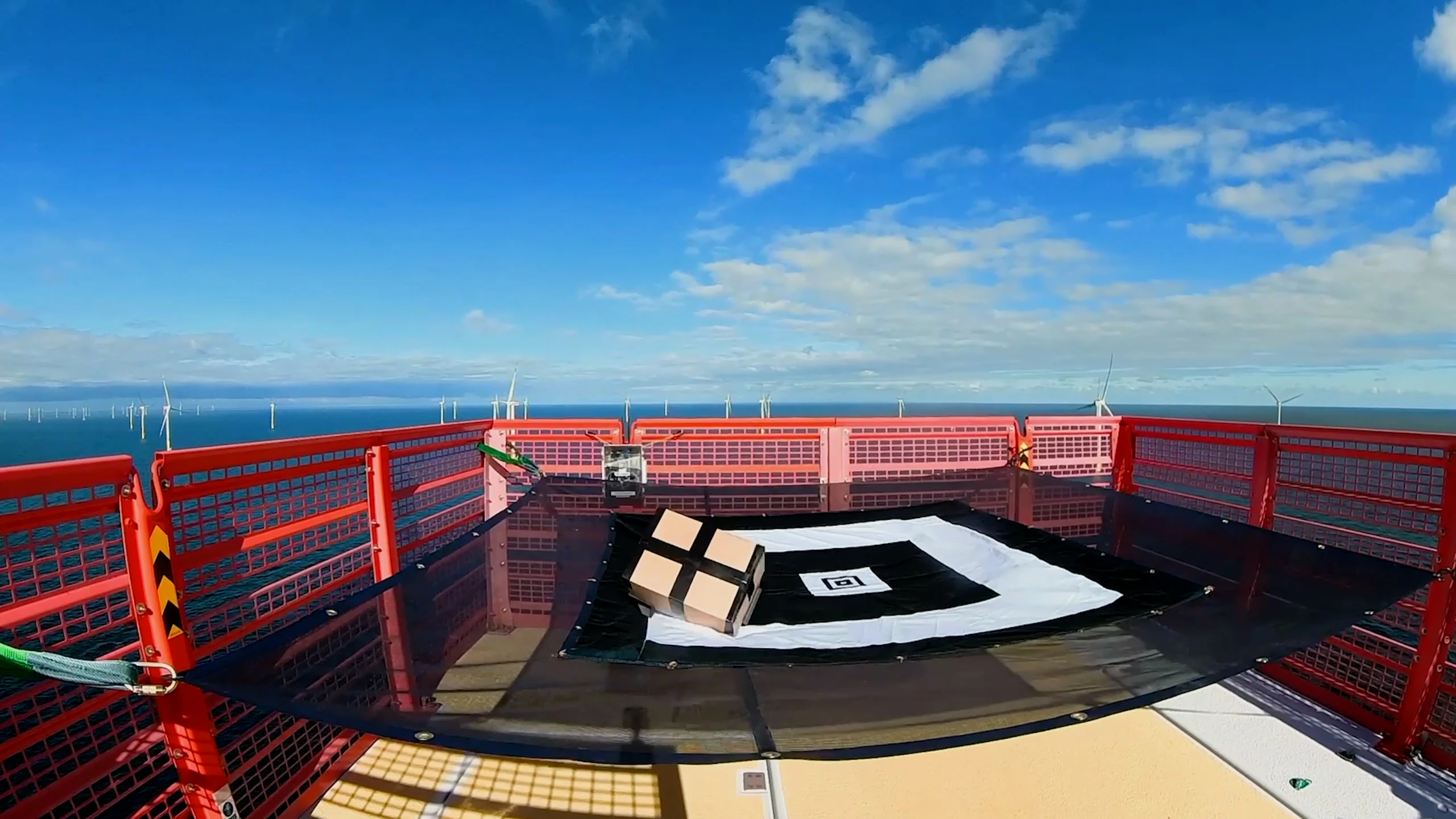
Offshore logistics: Skyways’ V2 has supported offshore wind farm deliveries where boats take hours, and weather dictates success. The emphasis is on time-to-delivery, autonomy, and precision in complex environments.
Military cargo between airports: Autonomous cargo flights for the U.S. military highlight repeatable operations in realistic conditions—not lab demos.
Scaling matters: A $37M USAF AFWERX award supports transitioning V3 from prototype to full-rate production—because logistics outcomes require manufacturing and deployment scale, not just aerodynamics.
Capabilities are expressed, but always tied to use cases:
V2 as a long-range, heavy-fuel “workhorse” (~450-mile class range, ~30 lb payload, ~8 hours endurance) supporting medical delivery, offshore operations, and remote logistics.
V3 for higher-throughput missions: 100 lb payload, 1,000+ mile class range, 20 hours endurance, designed for long-distance cargo, utilities, ISR, early fire detection, and emergency communications.
The uncomfortable truth
Customers don’t want a “drone program.” They want fewer truck rolls and vessel trips, less downtime, faster replenishment, safer operations, predictable delivery costs, better remote coverage—and, in some cases, lifesaving logistics.
The aircraft is only one component of the service that delivers those outcomes.
The real question isn’t, “How do we build a better aircraft?” It’s, “What outcome can we guarantee—and what operating model makes it repeatable?”
Continue the series: No One Cares About the Damn Aircraft, Part II


